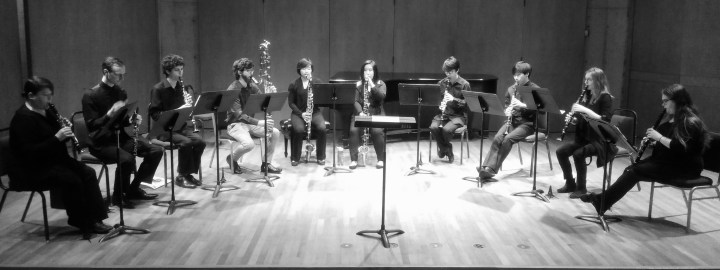
 Today my studio at UVic had and open master class. The clarinet choir also performed Dvorak. You can see pictures from this event on my twitter and listen to the recorded master class online.
News
Open Master Class Scores and Programme
Below you will find the programme and scores for the performances taking place during the open master class on Nov. 1st at 1pm PST in the Phillip T Young Recital Hall.
Philippe Gaubert, Fantaisie for Clarinette and Piano
Eugène Bozza, Aria
Felix Draeseke, Sonata for clarinet and piano
PASSEPARTOUT DUO: MUSIC ON THE MOVE
Here is the first in a series of interesting articles by percussion and piano duo, Passepartout, about their lives traveling and attending artist residencies without a home base. Chris and Nico are not only brilliant musicians, but also eloquent writers as well. This first article in their series can provide insight on their unique musical lifestyle. Click here to read their article.
Also watch Passepartout Duo perform.
The Cross-Cultural Clarinet
I will be performing “The Cross-Cultural Clarinet”, a concert of solo works for clarinet influenced by non-western cultures, at Acadia University. This concert will be January 11th 2019 in Denton Hall at 11:30am featuring works by Ziporyn, Shatin, Rosen, Azmeh, and Olsen. More details to come!
Aventa Ensemble Presents Ayre by Oswaldo Golijov
I’m thrilled to be performing Ayre by Oswaldo Golijov with the Aventa Ensemble! This performance will take place at the end of October. More details to come!
UVic Faculty Concert
I will be performing in the UVic Faculty Chamber Music Concert on October 13th at 8pm in the PTY Recital Hall. Click here for concert and ticket information!
Tips for Student Success
With a new term beginning I thought it would be a good idea to provide a few pointers for success during the term.
- Write practise times directly into your class schedule. This way you know exactly when you practise each day.
- Warm-up prior to you lessons and rehearsals. This will save time and allow for more time to focus on technique and repertoire.
- Always practise with a mirror, tuner, and metronome.
- Keep your reeds in rotation so you always have a good reed to play on. A bad reed can derail a lesson or practise session. See this article by Reiner Wehle on how to break in reeds. My motto: Life is too short to play on bad reeds!!!!!
- Your warm-up is the most important part of your practise. A good warm-up should include long tones, scale technique, and articulation.
- Organize your practise time. Practising should include a warm-up, etudes/studies, repertoire. Your practise time will vary depending on how much repertoire you are working on.
- Set small achievable goals for your practise sessions.
- Measure your practise time by tasks rather than time. Putting in multiples hours is useless if you don’t accomplish anything.
- Listen to other clarinetists and see as many live concerts as possible of varying genres, styles, and ensembles.
Materials for Lessons
Students should have a music folder for their lessons, a notebook, and pencil. Each students should download and print the Clarinet Warm Up Materials and bring them to each lesson.
Additional study books may include the materials listed below. I will suggest specific books during your lessons.
- Galper Method Book 1 and 2
- Rose, 32
- Rose, 40
- Kell, 17 Staccato Studies
- Uhl, 48 Studies
- Klose, Complete Method for Clarinet
- Langenus, Complete Method for Clarinet book 3
- Reiner Wehle, Clarinet Fundamentals vol. 2 Systematic Fingering Course
- Cavalini, 30 Caprices for Clarinet
- Baermann, Clarinet Method Third Division
- Kroepsch, 416 Progressive Daily Studies for the Clarinet
Reed Myths by Robert DiLutis
Here is a great article about adjusting and selecting reeds by Robert DiLutis.
Tips on practicing, intonation, and voicing
Here are a few useful articles on clarinet technique from BuzzReed.
Ten Tips to Teach Purposeful, Productive Practice
Finding Your Voice-ing
Tips for Tuning
Cherry Blossom and a Wrapped Thing: After Hokusai
I recently performed a beautiful piece by Judith Shatin titled Cherry Blossom and a Wrapped Thing: After Hokusai for amplified clarinet and fixed media influenced by a Japanese print with the same name.  This piece depicts the delicacy of Hokuasi’s print through very soft clarinet tones, almost in audible double stops, fluttering tongue, and the interweaving of clarinet and electronic sounds. Often when I perform works with electronics there is a disconnect between the clarinet sound and electronics; this is not the case in Cherry Blossom. In this piece the electronics and clarinet compliment each other in a delicate duet creating the effect of a close up survey of every detail in the print.
The extended techniques in Cherry Blossom are clearly explained in the performers notes. Having fingering and symbols clearly explained makes approaching this work very accessible. Additionally, the electronics setup is not challenging. I practiced this piece with the fixed media playing through iTunes. In performance the fixed media was also through my iTunes on my laptop to larger speakers with a mic to amplify my playing. In performance and practice I used the timer in iTunes to align with the fixed media. Another option is to use a stopwatch. I also used a stopwatch in a performance because my computer screen wasn’t visible.
The most significant performance challenges in this piece are voicing the multiphonics and linking gestures and musical ideas together. In my preparation a lot of time was spent finding the appropriate tongue position and air speed to make the delicate multiphonics speak. Often I used techniques opposite to traditional clarinet playing such as slow warm air and a low tongue position. Creating a musical line out of each gesture was also challenging. An example of this is shown below beginning at 4:35. In this example there are multiple extended techniques including multiphonics, flutter tongue, and multiphonic trills that need to be tired together into one gesture. I approached this phrase with the note D as the unifying pitch. D is played in

the first clarinet multiphonic, then the clarinet pitches moves away from this pitch. During this departure the electronics still reinforce D and G. The clarinet then moves back to D in the last three whole notes and is transformed with a multiphonic, and then a trilled multiphonic. Each event functions to change the colour of the pitch D. Understanding that D unifies this phrase makes it clear that D must be alway presents and the whole gesture organically shifts colour around this note. The effect is of panning closely over the wrapped thing in the Hokusai print. The close blend of the clarinet and electronics suggest the transparent and twisted quality of the wrapped thing.
Click here to learn more about Cherry Blossom and Judith Shatin.
Ecosono in Houston
I had a great time performing this passed weekend (April 13 and 14 2018) at Rice University’s Moody Center with the Ecosono Ensemble. On April 13 I was part of a free improv accompanied by glacier sounds, birds, and the wind blowing across the holes shrimp dig (very cool). April 14 I performed Matthew Burtner’s Climate Change Opera Auksalaq. It’s great to be a part of socially conscious engaging art!
Oberlin Orchestra Featuring Prof. Richard Hawkins Livestream
The Oberlin Conservatory Orchestra’s March 3rd 2018 8pm concert will be live-streamed. This concert will feature Prof. Richard Hawkins performing the John Corigliano Clarinet Concerto.
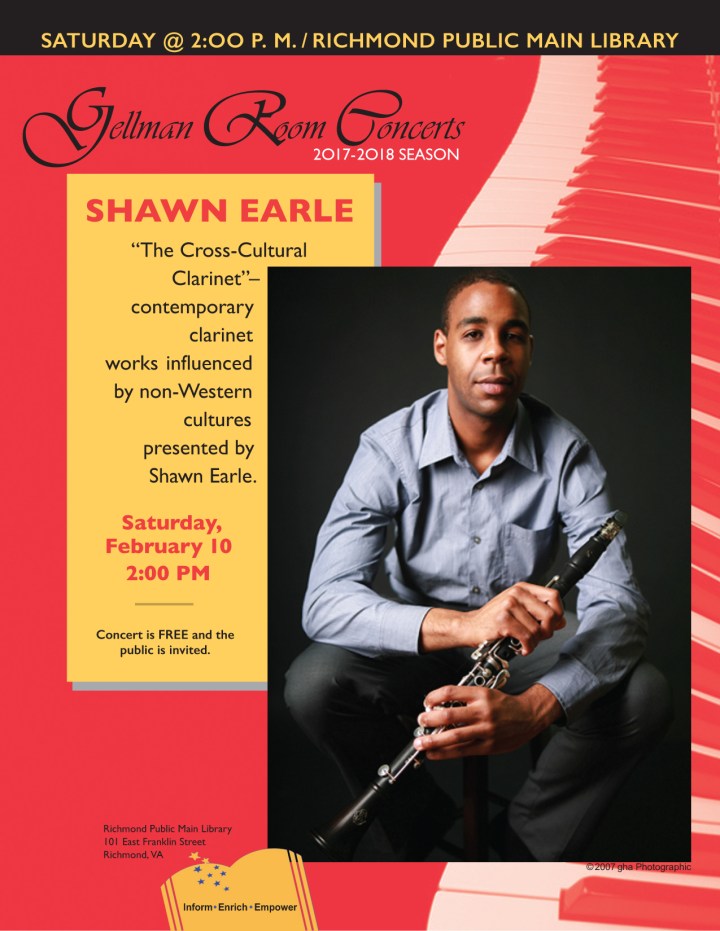
Gellman Room Concert
W&L Performance
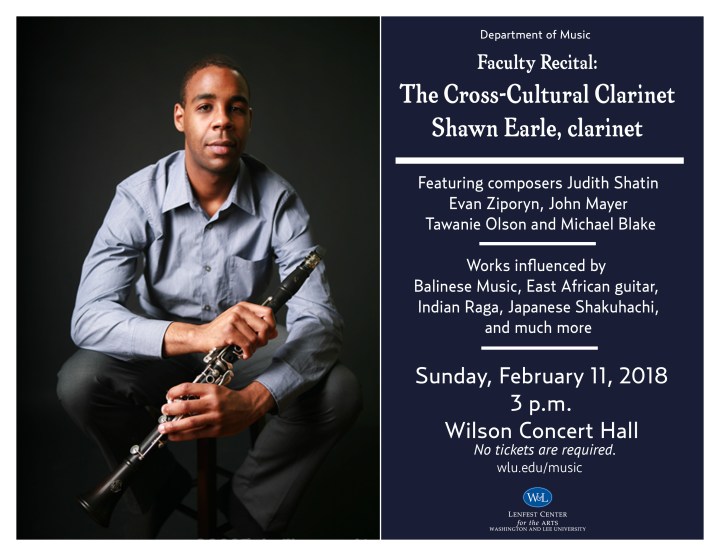
The Cross-Cultural Clarinet
I will be performing a concert of solo clarinet repertoire influenced by non-Western cultures which I have titled The Cross-Cultural Clarinet in February 2018. The concert will feature contemporary clarinet works influenced by East African Guitar, Japanese Shakuhachi, Balinese Gamelan, Pygmie Whistle Song, and more.
I have three concerts schedule:
- February 10th at 2pm in the Gellman Room at the Richmond, VA Public Library, Free Admission.
- February 11th 3pm Wilson Hall at Washington and Lee University, Free Admission
 Shawn Earle