The clarinet embouchure is a key element in creating a good sound. Characteristics of a good clarinet sound include dark, round, and focused qualities. A tight or poorly formed embouchure will inhibit these qualities. Below are steps for creating an embouchure that supports the dark, round, and focused sound.

  1. The top front teeth rest directly on the top of the mouthpiece
  2. The top lip goes in front of the top teeth down on the mouthpiece
  3. The bottom lip curls over the bottom teeth until the bottom teeth are directly below where the red of your lip meets the skin
  4. The corners of the mouth come in towards the mouthpiece like you are saying “Ooo”
  5. The chin should be in a normal or pointed position (not bunched).
Version 2
Becky Hissen and I performing New York Counterpoint. Notice our firm upper lips, pointed chins, and corners of the mouth drawn in.

The embouchure should be relaxed, but create enough seal around the mouthpiece and reed so that no air escapes. The lips should passively resist the mouthpiece with the top lip firm and the bottom lips creating a gentle cushion for the reed. A general rule is that you should see very little or no red of the lip.

The top lip is essential in creating a good tone. A firm upper lip down on the mouthpiece  (FULPDOMP) is an excellent cue to remember. A firm upper lip frees the bottom lip to relax which lets the reed vibrate freely. Also a firm upper lip down on the mouthpiece allows the soft pallet to rise which creates a rounder sound.

Be aware of changing the shape of the inside of the mouth while playing. This creates fluctuations in tone and intonation. The inside of the mouth should not be closed and narrow, but open and spacious. Think of the inside of the mouth like the inside of a large cathedral with a tall arched ceiling rather than a narrow crawl space.

The tongue should be in a “Eee” position while playing. This means it should be high in the back near the molars. Dropping the tongue low in the mouth creates an unfocused sound.

1923289_513052557626_565_n
Toby Moisey demonstrating that flute players can play with a good clarinet embouchure too! Notice the pointed chin and firm upper lip. Maybe he could take a little more mouthpiece.

The throat should be open when playing like you are saying “ah” or yawning. The air stream should be fast when playing. Think of fast air moving between your front teeth. Also, be aware that the air should be focused and fast like cooling soup or a hot drink with cool air under pressure rather than hot slow air like fogging a window.

Some general problems I have seen that restrict sound and make playing difficult are:

  1. Biting: This often happens when there is a lack of air support. Instead of supporting the sound with air, the embouchure works to support the sound. Some cues to help with biting are to think of opening your mouth more and making your back teeth farther apart. Also keep in mind that there is an equal force between the lips and the mouthpiece. You don’t want the lips to apply more force than the mouthpiece gives the lips.
  2. Angle of the Clarinet: The angle of the clarinet determines how much reed is exposed in the mouth. If the angle is too far out, the reed is dampened by the bottom lip. Generally when sitting the bell should be at knee height.
  3. Jaw and embouchure movement: Movement of the jaw and embouchure invites squeaks, fluctuation in pitch, and tone. Pointing the chin helps to reduce embouchure movement. As well, think of freezing the lips in one place like a ventriloquist.
  4. Lack of Air Support: Air support is essential for a good tone. Taking a breath when playing the clarinet fulfills three needs: 1) to keep us alive (obviously) 2) to blow through the instrument and vibrate the reed 3) to keep in storage at the bottom of the lungs to support the tone. This last function is often forgotten, but helps us to relax the embouchure so the reed can vibrate freely.
  5. Pinching off at the tip of the mouthpiece: Playing at the tip of the reed and mouthpiece pinches off the sound and limits the amount of reed that can vibrate. Here is a good way to determine how much mouthpiece to take. Hold any note and move the embouchure down the mouthpiece until the sound distorts into a squeak. Back off slightly so that you are in a safe space where it won’t squeak, this is about where you should be on the mouthpiece when playing.

The clarinet embouchure is something personal to develop. I have outlined what works for me and has worked for my students in my teaching practice, however each clarinetist has to experiment to find what works for them to create dark, round, and focused tone. You may have heard contradictory advice about embouchure from other clarinetists; they are explaining what works for them. Your job as a student is to take in all the information provided and experiment to find what works for you. Hopefully the points listed will set you in the right direction. For any questions please contact me directly.

Happy Practising!!!


I’m really excited to be joining EcoSono Feb 28th for a performance of The Ceiling Floats Away by Matthew Burner (music) and Rita Dove (poetry) as part of the Intersections Festival. I’m thrilled to be involved in such an innovative project! I won’t attempt to explain the project for fear of getting it wrong, but please read more on it here.

The performance will be Feb. 28th at the Atlas Performing Arts Centre in Washington D.C

I’m thrilled to announce that I have accepted the position of Lecturer in Clarinet at the University of Virginia McIntire Department of Music. Additionally, as part of this position I will be the principal clarinet of the Charlottesville Symphony at the University of Virginia. I’m excited to begin my new position with the outstanding faculty and students at UVa!!!

For details about the clarinet studio at U.Va click here 

In June 2016 Michal Rosiak, Maureen Kelly, and I will be artists-in-residence at Bundanon Trust in New South Wales, Australia. We will be artists-in-residence for two weeks working on works for flute, clarinet, and cello that will be performed at the beginning of July at the Unbound Flute Festival in Brisbane. We will be performing new works by Australian composers Michal Rosiak and Dr. Stephen Cronin, as well as works by Canadian composers.

More to come!!!

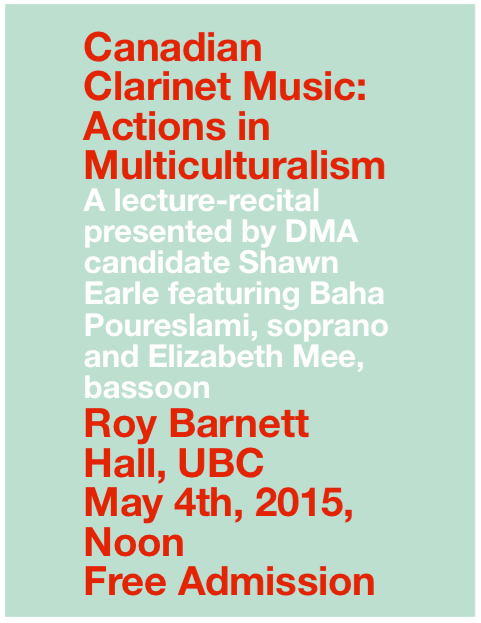
I will be delivering a lecture-recital on my DMA research topic Monday April 4th, 2015 at noon in Roy Barnett Hall in the UBC School of Music. This lecture will explore how art, specifically clarinet music, is an effective action in Canadian multiculturalism. I will also look at ways in which clarinet music is critical of multiculturalism. Baha Poureslami and Elizabeth Mee will join me to perform works by Milton Barnes, Robert Rosen, Elliot Weisgarber, and Derek Charke.

Click here for more details about my research

Poster

I will be delivering a lecture-recital on my DMA research topic Monday April 4th, 2015 at noon in Roy Barnett Hall in the UBC School of Music. This lecture will explore how art, specifically clarinet music, is an effective action in Canadian multiculturalism. I will also look at ways in which clarinet music is critical of multiculturalism. Baha Poureslami and Elizabeth Mee will join me to perform works by Milton Barnes, Robert Rosen, Elliot Weisgarber, and Derek Charke.

Click here for more details about my research

Poster

I’m not sure why I didn’t think of this sooner! Often people ask me about “good” Canadian works. In my research I have examined over 200 works for clarinet in the Canadian Music Centre’s collection. I have numerous bibliographies of works that I have complied which are consolidated into a “Shawn’s Favourite” list of works which I have included here. ENJOY!!! Shawn’s Favourite Canadian Clarinet Works

I recently performed Omar Daniel’s work Three Chambers for clarinet and piano in my third DMA recital. This is an exciting and challenging work with a program that makes contemporary music accessible to all audiences. Each movement is based on a scene or sentiment evoked in an Italian horror film. As well, accompanying each movement are wonderful descriptive titles: “Tarantella”, “A Raven in the Opera House”, and “Out of the Ashes Rises and Angel”.

“Tarantella” uses the movie Demons as inspiration. In an interview posted on the Canadian Music Centre website, Daniel explains that this movement captures the mood of the film. In the film, fantasy becomes reality for teenagers watching a horror movie when they are attacked by zombies. The music reflects this chaos being loud, wild, and rhythmically driven. “Tarantella” immediately catches the audiences attention with the piano playing two loud chords answered by altissimo glissandi in the clarinet. The opening section sets the scene, like a narrator introducing characters in a story. Tremolos interrupted by wild accelerating runs are accented by loud chord clusters in the piano. Slow practice and drilling these passages was necessary to ensure they became automatic. Most of the trills were comfortable, but there were a few from A sharp 5 and C sharp 6 that required trick fingerings. I used the side key A sharp, trilled to overblown F sharp. The return to the introductory fast passages lies much more comfortably than at the beginning. However, the trills are more awkward, such as A sharp 4, to C sharp 5. I used regular fingerings for this tremolo, but begun the trill slow eventually getting faster. This solution created the effect of a smooth even trill, while accommodating the technical challenges of playing over the break. To organize the accelerating irregular passages, I grouped them into sections of two, three, and four sixteenth notes. I made certain to communicate these groupings to my pianist to aid following my part. No time signature is indicated, which makes placement of the piano interjections challenging, but also contributes to the free narrative/dialogue-like quality. Ultimately, in performance I did not directly pay attention to the piano line, but took the lead and allowed my pianist to add the interjections into my part.

An extensive virtuosic piano solo follows giving way to the dance-like middle section where the true essence of the Tarantella dance is shown. The clarinet plays a continuous lilting rhythm while the piano accents big beats one and two in 12/16. A number of transformations of this dance section occur, each becoming more virtuosic for the clarinet. I felt it was necessary to feel this section in two rather than four. If I counted in four, I would get lost and the section became beat heavy and slow. Maintaining energy and momentum is the biggest ensemble concern in this section, especially as it becomes increasingly more technical. “Tarantella” is relentless in dynamic, energy, technique, and momentum. It is not until the end of the movement that calm is achieved, but even this calm is kept frantic with continuous sixteenth notes circling in the bass of the piano.

The second movement “A Raven in the Opera House” is for solo clarinet, and dramatically contrasts the chaos, loud, and violent nature of “Tarantella”. Daniel explains that this movement draws inspiration from the film The OperaIn this film there is a scene where the action is filmed from the perspective of a raven, which swoops and dives in the opera house. The clarinet takes on the role of the raven in this movement. The paring of the niente effect with continuous oscillations between the notes B and D create the effect of the ravens wings echoing throughout the opera house. As the piece progresses the oscillating notes always return to D, in alternation with notes progressing downward in the chalumeau register to E, contributing to the imagery of the raven diving and ascending.

Alternations between D and B are not indicated with slurs in the score suggesting a tongued articulation. To tongue this movement would create an effect contrary to the smooth and fluttering quality of bird flight. I concluded that a slurred articulation, with the use of an aggressive finger action to articulate each note, was the best option. Michael Rusinek, the clarinetist this piece was composed for, also slurs this section on the recording posted on the CMC website. Additionally, to produce a seamless long musical line I decided to circular breathe in the opening section. There are fermatas throughout where a breath can be taken, however I discovered that breathing after the fermatas disrupted the phrase.

The middle section of this work is composed on two staves. The top line is indicated to be improvisatory, while the bottom is a return to the oscillations of the first section. I ensured a quick transition between the two staffs and a tone change to show two separate characters. “A Raven in the Opera House” is my favourite movement in Three Chambers. It is haunting and captivating, employing simple musical ideas in effective ways. This movement draws the audience in through the masterful crafting of sound to create vivid imagery.

Omar Daniel states that the final movement, “Out of the Ashes Rises an Angel”, draws inspiration from the film The SectIn this movie a woman is chosen to carry the spawn of Satan, similar to the Roman Polanski horror, Rosemary’s Baby The scene in The Sect which inspires this final movement is where the main character is in a car crash, but escapes from the the wreckage unharmed. The music in “Out of the Ashes Rises an Angel” depicts this with a long meandering piano solo to start. This piano solo is like a camera panning to survey the car wreckage. When the clarinet enters a slow mournful through-composed melody is accompanied by a slow pulsing ostinato in the piano. The melody rises in pitch and tension throughout until the end.

My biggest challenges were counting and stamina in this movement. When the clarinet enters the time signature is 3/4, however the piano is playing triplets with ties. It took me an embarrassing amount of time to realize that if I counted in 9/8 I was able to follow the piano rhythm more accurately. Upon counting in 9/8, rather than 3/4, everything rhythmically fell into place. The final movement of Omar Daniel’s Dream’s of the Panther also uses a similar method of poly meter which can be confusing for the performer, but is effective in creating a sense of anxiety and forward motion in the music. Three Chambers is not an easy work to perform. At times the first movement is physically violent for the clarinet player, the second movement requires intense control, and the final a finesse of tone in the altissimo register. By the end of this work my face was very tired. I was grateful to hear in Rusinek’s recording that he transposed the final altissimo passage down an octave to the clarion. I completely understand why he chose to do this, and I did the same. The risk of squeaking at the very end was too great. Daniel states that the movements of Three Chambers can be performed individually. Performing “Out of the Ashes Rises an Angel” on its own would allow for a comfortable and less fatigued performance of the altissimo register at the end.

Three Chambers is a challenging work to perform, but absolutely worth the time and effort. What I enjoy most about this work is its use of contemporary idioms that are accessible to all audiences through the use of Italian horror genre of film as an entry point. No one expects a piece of music about a zombie invasion to be lyrical or sound like Mozart. I have only performed this work once and look forward to more performances in in the future.  There are a great deal demands required of the clarinetist in Three Chambers, but I feel like I’m a better clarinetist having conquered them.

Click here to listen to a full recording I did of Three Chambers.